
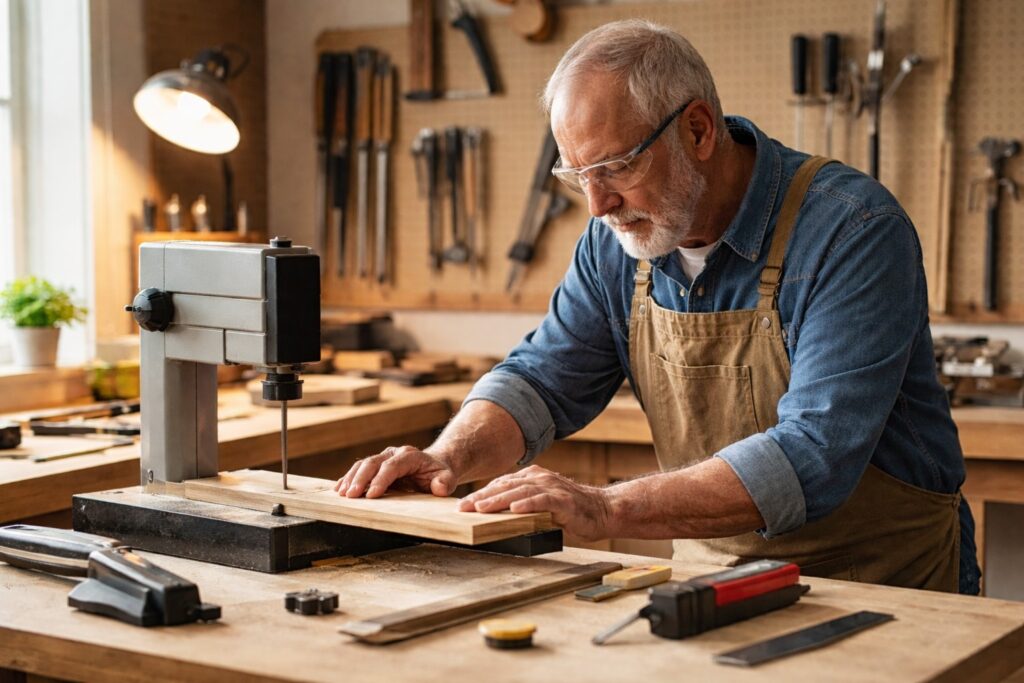
Woodworking doesn’t stop being meaningful just because you get older. Many seniors continue building, repairing, and creating with wood well into later life. When older adults search for safe woodworking tools for seniors, they are not expecting woodworking to become risk-free — and they are not asking for unrealistic guarantees.
What they are really asking is:
“What actually reduces the chance of serious injury while woodworking at my age?”
This pillar article explains the truth behind woodworking safety for seniors — what “safe” really means, why no tool is completely risk-free, and which design principles, habits, and setups matter most. It does not recommend specific products. Instead, it gives you the framework to make safer choices and points to focused guides that go deeper where needed.
A Reality Check: There Are No Truly “Safe” Woodworking Tools
No woodworking tool eliminates risk entirely. Blades are sharp, motors are powerful, and wood behaves unpredictably. What does change with age is how much margin for error matters.
For seniors, woodworking safety is less about speed, productivity, or power — and more about injury severity, control, and reaction time.
According to data and safety guidance from the Consumer Product Safety Commission, many serious workshop injuries occur during brief lapses in control rather than prolonged misuse — which is why reducing injury severity matters more than eliminating risk entirely.
While no tool removes risk completely, choosing designs that reduce injury severity and allow time to react can make a meaningful difference.
This principle guides everything that follows.
What “Safety” Means for Senior Woodworkers
For seniors, a safer woodworking setup typically emphasizes:
- Forgiveness when a mistake happens
- Predictable motion instead of sudden force
- Reduced kickback or torque
- Physical distance between hands and cutting edges
- Lower vibration and strain
- The ability to stop or recover quickly
In other words, safety is about reducing damage, not pretending accidents won’t happen.
Why Speed Becomes a Liability With Age
High-speed tools reduce reaction time. A mistake that might have been recoverable years ago can become more serious when movements are slower or grip strength is reduced.
This is why many seniors naturally gravitate toward:
- Slower cutting actions
- Tools that cut in a predictable direction
- Designs that allow deliberate, controlled movement
Speed is rarely the priority. Control is.
(We explore this idea in depth in the supporting article “Best Woodworking Tools for Seniors Who Want Control, Not Speed.”)
Kickback: One of the Greatest Injury Risks
Kickback — when wood is thrown back toward the user — is responsible for many severe woodworking injuries. Tools and setups that reduce kickback risk are often considered lower-risk for seniors.
Factors that influence kickback risk include:
- Direction of blade movement
- Feed rate control
- Stability of the workpiece
- Use of guides, fences, and supports
Understanding kickback — and choosing tools or methods that minimize it — is often more important than choosing a “stronger” tool.
(For seniors specifically looking to reduce table saw–related injuries, see “Best Cutting Tools for Seniors Who Want to Avoid Table Saw Injuries.”)
Physical Comfort Is a Safety Issue
Discomfort leads to fatigue. Fatigue leads to mistakes.
For seniors, woodworking safety is closely tied to how the body feels during and after a project. Strain and discomfort don’t just affect enjoyment — they directly affect focus, reaction time, and control.
Common physical factors that influence safety include:
- Hand and wrist strain
- Vibration exposure
- Grip comfort
- Balance and stance
Guidance summarized by the Centers for Disease Control and Prevention shows that age-related changes in strength, balance, and recovery increase injury risk during everyday activities, especially when fatigue is involved. In a workshop, this means tools and setups that aggravate pain or strain can quietly increase risk over time — even if they feel manageable at first.
This topic is explored further in “Best Woodworking Tools for Seniors With Hand or Wrist Pain.“
Why Accessories Matter as Much as Tools
Many woodworking injuries happen not because of the tool itself, but because hands are too close to danger or workpieces shift unexpectedly.
Safety accessories are not optional add-ons — they are part of the system.
Common examples include:
- Push sticks and push blocks
- Clamps and vises
- Featherboards
- Adequate task lighting
These items often provide more real-world protection than upgrading a tool.
(We break this down in “Best Safety Accessories for Seniors (That Actually Get Used)” and “Push Sticks, Push Blocks, and Clamps: Keeping Hands Away From Blades.”)
Lower-Risk Tools vs. Higher-Risk Tools
No tool category is completely safe, but some designs are generally considered less forgiving than others.
Tools that often require extra caution include:
- High-RPM cutting tools
- Tools that pull material toward the user
- Tools that require hands close to blades
- Tools with sudden torque or kickback potential
Lower-risk woodworking tends to involve:
- Slower, controlled cutting
- Vertical or downward cutting motion
- Stable, well-supported workpieces
(These patterns are discussed further in “Lower-Risk Woodworking Tools Seniors Commonly Use.”)
When Woodworking May Need to Change — or Pause
For some seniors, woodworking remains safe with thoughtful adjustments. For others, continuing in the same way may no longer be advisable.
Extra caution — or alternative approaches — may be needed when:
- Balance issues increase fall risk
- Vision cannot be adequately corrected
- Hand tremors affect fine motor control
- Fatigue or pain interferes with focus
In these situations, woodworking may shift toward:
- Simpler projects
- Seated work
- Assisted environments
- Or different creative outlets altogether
Knowing when to adjust is a sign of experience, not failure.
(This is explored honestly in “When Woodworking Becomes Unsafe With Age — And What to Do Instead.”)
Final Thoughts: Safety Is a Series of Thoughtful Choices
When seniors ask about safe woodworking tools, they are not asking for guarantees. They are asking for confidence, control, and protection when something goes wrong.
Safety comes from:
- Understanding risk
- Choosing forgiving designs
- Using proper accessories
- Respecting physical limits
- Working at a deliberate pace
This pillar page exists to give you that foundation. The supporting articles in this series go deeper into specific concerns, situations, and solutions — so you can keep woodworking both meaningful and responsible.
Where to Go Next
- Control over speed: Best Woodworking Tools for Seniors Who Want Control, Not Speed
- Avoiding severe cutting injuries: Best Cutting Tools for Seniors Who Want to Avoid Table Saw Injuries
- Managing pain and strain: Best Woodworking Tools for Seniors With Hand or Wrist Pain
- Essential safety gear: Best Safety Accessories for Seniors (That Actually Get Used)
- Hand placement and distance: Push Sticks, Push Blocks, and Clamps: Keeping Hands Away From Blades (coming soon)
- Hard truths: When Woodworking Becomes Unsafe With Age (And What to Do Instead) (coming soon)
Frequently Asked Questions
Are there truly safe woodworking tools for seniors?
No woodworking tool is completely safe at any age. For seniors, safety focuses on reducing injury severity, improving control, and allowing more time to react if something goes wrong.
What actually reduces woodworking risk for older adults?
Risk is reduced by choosing forgiving tool designs, working at slower speeds, minimizing kickback, keeping hands farther from blades, and using proper safety accessories and lighting.
Is slowing down more important than using newer tools?
Often, yes. Deliberate pace, stable setups, and predictable cutting motions can reduce risk more effectively than simply upgrading to newer or more powerful tools.
Why does reaction time matter more as we get older?
Small changes in reaction time mean mistakes can escalate faster. Tools and setups that provide a margin for error help reduce the chance of serious injury.
When should seniors consider changing how they woodwork?
Woodworking may need adjustment when balance, vision, grip strength, or fatigue begin affecting control. This doesn’t mean stopping — it often means adapting projects, tools, or techniques.